Mademoiselle Fifi and Tales of the Woodcock
Guy de Maupassant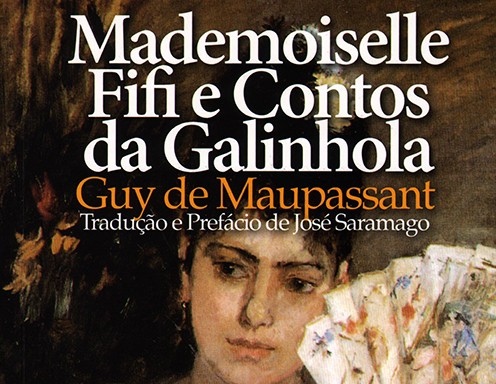
In 2012, Relógio D'Água published Mademoiselle Fifi and Tales of the Woodcock, with a translation and preface by José Saramago, recovering Guy de Maupassant's Novels and Stories, which Saramago had translated for Estúdios Cor in 1965. The preface corresponds to the original text published at the time and is an authentic treatise on Maupassant and the naturalist aesthetic, the realism of Flaubert, of whom Maupassant was a disciple "in the true sense of the word," and literature, of which Saramago already said that "it is not a career" and that "the writer cannot forget that he is, first and foremost, a man and only then a writer, that the latter should not replace the former, and that it is fundamentally a man's duty to be true to himself, to his profound truth, whatever it may be, and to express himself in accordance with it, sincerely and completely. The writer's usefulness lies there, that is his reason for existence.".
Beyond the biography of the author of *Boula de Sebo* and a social and cultural contextualization, Saramago discusses realism and naturalism as concepts and artistic genres, grounding his own vision of Maupassant: “His naturalism, since it is necessary to accept the label, is nothing more than a taste for popular life, for the picturesque, for lively and biting satire that does not spare certain social 'values' that he will later, prudently, seek to put on his side,‘ thus not fitting ’within the narrow limits that, at least theoretically, the naturalists have set for themselves.” Throughout this text, Saramago always assumes a critical position not only towards literary history, referring to the absence of Maupassant in Júlio Lourenço Pinto's *Estética Naturalista* (1885), but also towards the very need and relevance of defining artistic movements such as those in question, as well as a certain “careerism” of Maupassant for whom “'career' will be almost everything in (his) eyes.”.
“For Maupassant, the world is a night without dawn. There is no peace, no joy, no happiness. There is only the wrong life, the wrong man, the chilling stupidity of the articles and clauses of the contract that constitutes men in society.” (José Saramago, 1963)
This preface by José Saramago was initially published in Bola de Sebo and A Casa Tellier de Maupassant, by Estúdios Cor in 1963.