Lanzarote Notebooks I
Writing a diary is like looking in a mirror of trust, trained to transform mere good looks into beauty or, in the worst cases, to make the utmost ugliness bearable. No one writes a diary to say who they are. In other words, a diary is a novel with only one character. In other words still, and finally, the central question always raised by this type of writing is, I believe, that of sincerity.
Foundation
Portugal
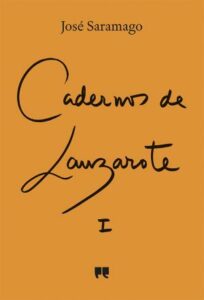
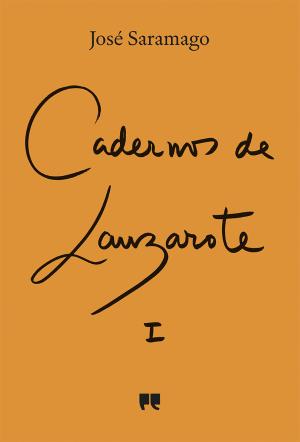
The calligraphy on the cover is by the painter Graça Morais.
"This book, which life having and health not lacking will continue, is a diary." In 1994, having left Portugal after being censored by the government of Cavaco Silva in the episode of the candidacy of The Gospel According to Jesus Christ for the European Literature Prize, Saramago edited the first of his controversial Cadernos de Lanzarote. A sample: «August 7: Congratulations from Jorge Amado and Zélia for the awards. That others will come, even bigger, they add, alluding to what is said to have been said by Torrente Ballester – that one of these days a phone call comes to me from Stockholm… If these people really believe what they say, why do I have so much difficulty believing it? » Between words, he launches ideas about the book he was currently working on: Essay on blindness.
Path – Leya
1994, 2nd ed., 1994
Language
Portuguese
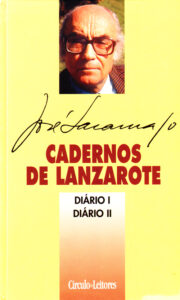
«This book, which, if life and health allow, will continue, is a diary.” In 1994, having left Portugal after the Lara incident in the European Literature Prize application episode, Saramago published the first of his controversial ”Lanzarote Notebooks.“ An excerpt: ”August 7th: Congratulations from Jorge Amado and Zélia on the awards. They add that others, even greater, will come, alluding to what Torrente Ballester supposedly said – that one of these days I’ll get a phone call from Stockholm… If these people really believe what they say, why do I have so much difficulty believing them?“ Between words, he throws out ideas about the book he was working on simultaneously: ”Blindness.“ (Diário de Notícias, October 9, 1998)
Circle of Readers
1998 (included in the work Lanzarote Notebooks – Diary I and Diary II)
Language
Portuguese
Circle of Readers
1998 (included in the work Lanzarote Notebooks – Diary I and Diary II)
Brazil
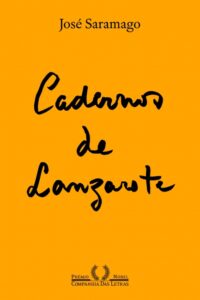
2023 (included in the work Lanzarote Notebooks with writings from the years 1993, 1994 and 1995)
Language
Portuguese
The calligraphy on the cover is by the writer Leyla Perrone-Moisés.
The great Portuguese storyteller opens his diaries and offers a veritable feast of reflections and outpourings on a wide variety of topics, treated with frankness, good humor, and great intelligence.
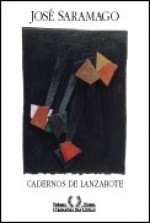
1997 (included in the work "Lanzarote Notebooks" with writings from the years 1993, 1994 and 1995)
Language
Portuguese
The behind-the-scenes world of international literary awards, the camaraderie with fellow writers like Jorge Amado, the fight against political and religious obscurantism that condemns his works as subversive and blasphemous, the writer's intimate dilemmas regarding his work: all of this is contained in the pages of these diaries by José Saramago, the greatest Portuguese author of our time, written between 1993 and 1995 in the quiet village where he lives, in Lanzarote, one of the Canary Islands, or during his numerous travels around the world. Alternating between the serenity of someone who has lived a long life and the indignation of someone who never tires of fighting against what he considers wrong, Saramago gives in this book a unique testimony of dedication to literature and to life.
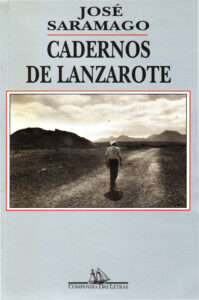
1997 (included in the work "Lanzarote Notebooks" with writings from the years 1993, 1994 and 1995)
Language
Portuguese
The behind-the-scenes world of international literary awards, the camaraderie with fellow writers like Jorge Amado, the fight against political and religious obscurantism that condemns his works as subversive and blasphemous, the writer's intimate dilemmas regarding his work: all of this is contained in the pages of these diaries by José Saramago, the greatest Portuguese author of our time, written between 1993 and 1995 in the quiet village where he lives, in Lanzarote, one of the Canary Islands, or during his numerous travels around the world. Alternating between the serenity of someone who has lived a long life and the indignation of someone who never tires of fighting against what he considers wrong, Saramago gives in this book a unique testimony of dedication to literature and to life.
Spain
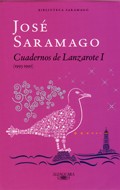
2011 (Saramago Library Collection) (Translated by Eduardo Naval) (included in the work Cuadernos de Lanzarote (1993-1995))
Language
Spanish
José Saramago reveals to us in these pages his day to day experience in Lanzarote, where he spent his residence in 1993. He is accompanied by questions and answers, of certain and radiant opinions about the closest and most general, of comments about friends and about the world that has touched him, that has touched us, living.
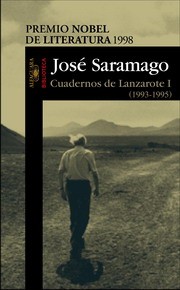
2001 (Trans.: Eduardo Naval)(included in the work Cuadernos de Lanzarote (1993-1995))
Language
Spanish
José Saramago reveals to us in these pages his day to day experience in Lanzarote, where he spent his residence in 1993. He is accompanied by questions and answers, of certain and radiant opinions about the closest and most general, of comments about friends and about the world that has touched him, that has touched us, living.
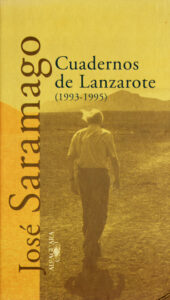
1997 (Trans.: Eduardo Naval)(included in the work Cuadernos de Lanzarote (1993-1995))
Language
Spanish
José Saramago reveals to us in these pages his day to day experience in Lanzarote, where he spent his residence in 1993. He is accompanied by questions and answers, of certain and radiant opinions about the closest and most general, of comments about friends and about the world that has touched him, that has touched us, living.
Italy
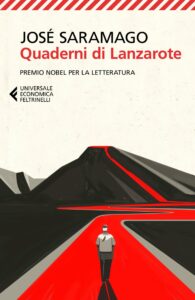
2010; 2011 (Translated by Rita Desti) (included in the work Quaderni di Lanzarote; Selection of Texts)
Language
Italian
“La riverenza e la deferenza som virtù perverse que easimente puedo convertirsi en soggezione e humiliazione”
For the fury of the polemic aroused by the publication of his book Il Vangelo secondo Gesù Cristo appeared in 1991, José Saramago decided to transfer it, in a sort of autoesilio, from Portogallo to Lanzarote, in Canarie. That great Lusitanian writer began to have a negative story between 1993 and 1997, a sort of daily diary, which came together in the Quaderni di Lanzarote. Lettere indirizzate alla moglie Pilar, agli amici più stretti e agli scrittori incontrati nel corso di una vita letteraria, que hanno la forza di segnare un vero e proprio mundo sentimentale, dove traspare la sua vena più personale e riservata. I'm already very important in its evolution, which is already very important in its contribution to its achievement of the Nobel Prize (which was awarded in 1998). Accanto alla presenza della moglie Pilar, trovano quindi spazio molte riflessioni sulla scriptura, senza certain dimenticare la bellezza del paesaggio, dell'isola di Lanzarote e delle Canarie. A magic cornice for one I gave great writings from the second dopoguerra.
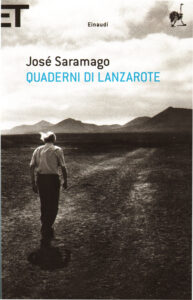
Einaudi
2010; 2011 (Translated by Rita Desti) (included in the work Quaderni di Lanzarote; Selection of Texts)
Language
Italian
«Write a diary and save it in one specchio di fiducia, adding it to transforming it into a beauty that always looks beautiful, in the peggiore dei casi, rendering sopportabile the bruttezza massima. Nessuno write a diary per dire chi è. In other parole, a diary is a novel with a solo character».
This edition is a scelta on the page published in Cadernos de Lanzarote between 1994 and 1998. The last novel by José Saramago (Azinhaga, 1992) published by Einaudi is Il viaggio dell'elefante.
Einaudi
2010; 2011 (Translated by Rita Desti) (included in the work Quaderni di Lanzarote; Selection of Texts)
Language
Italian
«Write a diary and save it in one specchio di fiducia, adding it to transforming it into a beauty that always looks beautiful, in the peggiore dei casi, rendering sopportabile the bruttezza massima. Nessuno write a diary per dire chi è. In other parole, a diary is a novel with a solo character».
This edition is a scelta on the page published in Cadernos de Lanzarote between 1994 and 1998. The last novel by José Saramago (Azinhaga, 1992) published by Einaudi is Il viaggio dell'elefante.
Mexico
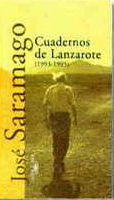
Alfaguara
(included in the work Cuadernos de Lanzarote (1993-1995))
Language
Spanish
A vital and artistic itinerary that documents the past with the same strength and humanity that reflects the present, to join the next. A new question about the obstinacy of life, which conjures indifference and the boredom of being.