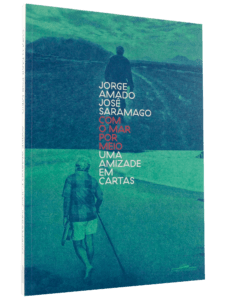
Last notebook from Lanzarote
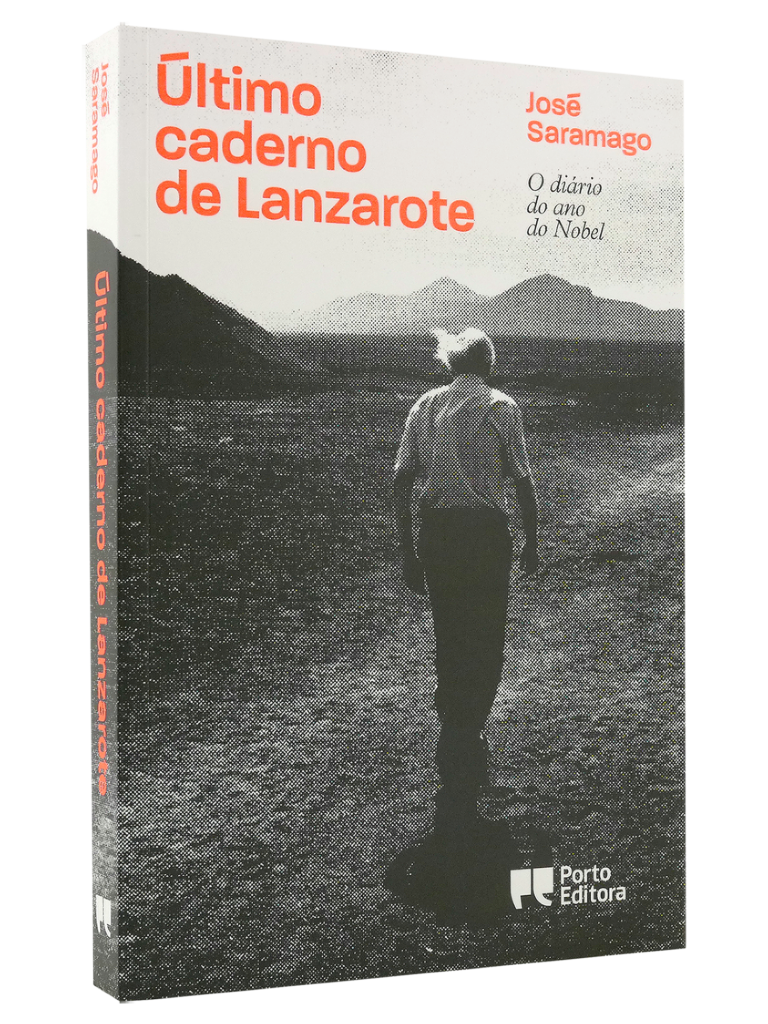
Published in 2018, it is the sixth volume of José Saramago's diaries.
The “last notebook of Lanzarote” refers to the year 1998, the year in which the writer was awarded the Nobel Prize.
Portugal
On October 8, 1998, we learned that José Saramago had won the Nobel Prize in Literature. On October 8, 2018, we celebrated that date with the publication of an unexpected unpublished work by the writer, the sixth and final volume of his diaries, Último Caderno de Lanzarote (Last Notebook of Lanzarote).
«"Two reasons led me, more or less consciously, to keep a diary: firstly, the circumstance of having left my country to live on this distant island; secondly, the need, which I had never experienced before, to 'retain' time, to force it, so to speak, to leave as many signs of its passage as possible. Lanzarote Notebooks is like a long letter sent to those who remained on the other side, but it is also a way (vain, useless, perhaps even desperate…) of pretending to prolong life through an obstinate 'writing down' of the days. The Notebooks are not a laboratory, although they do not lack reflections on the literary 'making'; they are not a record of world events, although comments on current affairs abound; they are not a collection of data for a future biography, although they do say what I do and what I think." Like all diaries (like all writing), the Lanzarote Notebooks are a narcissistic exercise, but, contrary to popular belief, Narcissus doesn't always like what he sees in the mirror in which he contemplates himself…“
Brazil
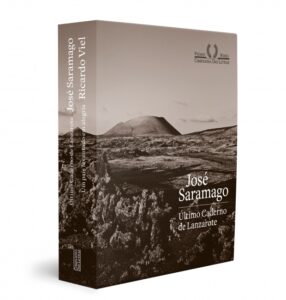
This special box set brings together José Saramago's previously unpublished diary, written during the year he received the Nobel Prize in Literature, 1998, and journalist Ricardo Viel's book about the reception of the prize in Portugal and around the world.
In early 2018, eight years after José Saramago's death, unpublished writings from the emblematic year of 1998 were found on his old computer. That year, the great Portuguese writer received the Nobel Prize in Literature, an event that drastically changed his life. *The Last Notebook of Lanzarote* is a kind of diary of the writer, the sixth and final volume of notebooks he kept while living on the Spanish island. In an informal tone, he comments on and reflects on his daily life throughout the year, culminating in October with receiving the most prestigious prize in the literary world.
The volume "A Country Raised in Joy" retraces the news of the first Nobel Prize in Literature awarded to a Portuguese-language author, revealing unknown episodes, presenting the messages received by José Saramago, and celebrating, twenty years later, an award that was intensely celebrated throughout the world.
“Ricardo Viel knows how to use science and serenity to recount those eventful days. In doing so, he constructs a landmark work about that incredible gift, that end of 1998.” — José Luís Peixoto
Spain
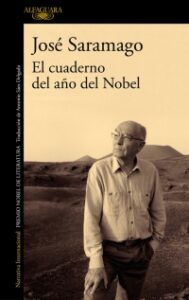
Alfaguara / Penguin Random House
2018 (Trans.: Antonio Sáez Delgado)
Language
Spanish
«It was days ago twenty years ago, it was days ago. The author was speaking from a new age in Lanzarote, the words coming out in spurts, month after month, a whole year, this year.»
Pilar del Río
The result of a fortuitous entry into the archive of José Saramago, this book is the last of the personal diaries that the Portuguese writer wrote and which ended up, as the author himself declares, «clutched on the computer's hard drive.»
In its pages, which cover the life of José Saramago during 1998, there are personal points, but above all there are reflections and ideas about his cultural and ethical stance. Ahí radica, without a doubt, his exceptionality: in them the reader discovers that the way of understanding Saramago's world - always from the perspective of the human being, always from the sensitivity hacia the disadvantaged, the vulnerable, the oppressed by the system - is more necessary today, more urgent than ever. Your voice invariably brings us alive because, as you intuit, the time is an elastic band, and being close to the ground depends on your will.
When twenty years have passed since the award of the Nobel Prize, this diary comes to light - just as José Saramago wrote it - together with the four conferences he gave in 1998, a year that forever changed the author's life and work.
The review says about the author and his work:
«A man with a sensitivity and a capacity to see and understand that is very much above what we generally see and understand in mortal communities.»
Hector Abad Faciolince
«El José Saramago who wrote and reflected until the end of his existence was a transgressor; transgressor in literature, in life and before the norms of conduct marked by the bourgeoisie.»
Yanet Aguilar Sosa, El Universal
«We must salute this return of Saramago, always an exceptional writer, to his initial realism, and encourage him to follow this path...»
Rafael Conte, Babelia (about Las pequeñas memorias)
«The always philosophical tone of Saramago achieves in All His Names a clarity and a despojamiento that allows him to speak of a voluntary metaphysical inquiry […]. Saramago has a dense report, but not boring; He is demanding in terms of his goals, but his plot does not allow him to lose his attention.»
Santos Sanz Villanueva, El Mundo (about All the Names)
«Saramago is a great narrator and rarely escapes the criterion of keeping the reader in the cell…»
Jordi Gracia, La Vanguardia (about All the Names)
«Probably the most sovereign and ferocious work of his indisputable narrative bibliography... If he has gained admiration in his own right, he also has the respect of every good reader for his constant overcoming of what he achieved, book after book...»
Robert Saladrigas, La Vanguardia (on Ensayo sobre la blindness)
Italy
Diario dell'anno del Nobel is the last quarter of Lanzarote, relative to 1998. If we didn't know what happened, Saramago said he promised it then and there in 2001, but if it didn't last the trace. Prima gli impegni, poi un cambio catartico di computer, e il sesto quaderno si è smarrito, seppellito in a machine that nessuno used più. Come racconta la moglie Pilar del Río nell'introduzione, ci sono voluti vent'anni e varie casualità “saramaghiane” perché questo testo venisse alla luce, ma forse ciò non è stato un male, certain riflessioni e confidenze dovevano aspettare.
I mainly focus on politics, I travel, the social dimension of writing and intelligence, and anchors the personal sphere and literature. Svetta il discourso proferito in occasione della consegna del Nobel, se il punto più alto della susistenza, ma nel compleso que questo quaterno restituisce al lettore una dimensione intima, a tratti perfino domestica, di Saramago, e risulta agevole e intriguing ricostruire i fili che unicono uno altro, come em una fitta ragnatela, I fear how animated the writing of this authentic genius of writing.
I wrote about Saramago's story in one of my computers at home, in the last quarter of Lanzarote, in the last year, relating to 1998.
Romania
2021 (Translated by Simina Popa)
Volum apărut cu sprijinul finance agreement de DGLAB/Culture şi Camões, IP – Portugalia.
Language
Romanian
„Unele cărți au nevoie de o explicație, iar aceasta este una entre ele. Voastre, la douăzeci de ani după ce au fost scrise și la 17 ani după ce autorul anunțase că vor apărea în curînd, pentru că destinul cărților scrise este să ajungă la cititori, și nu să rămînă în uitarea pe care o reprezintă hard diskul computerului. […] Desigur, volume apare așa cum la lăsat scris José Saramago. Și nu, nu ajunge tîrziu, Caietul apare în momentul în care este mai mare nevoie de el: veți înțelege la ce mă refer cînd veți înainta cu lectura. Douăzeci de ani mai tîrziu este momentul potrivit pentru anumite reflecții și confidențe.” (Pilar del Río)
„Autorul Memorialului ne lasă, ca Chateaubriand, ultima verba a sa pe un computer. reverberații fără sfîrșit.” (Eduardo Lourenço)